| |
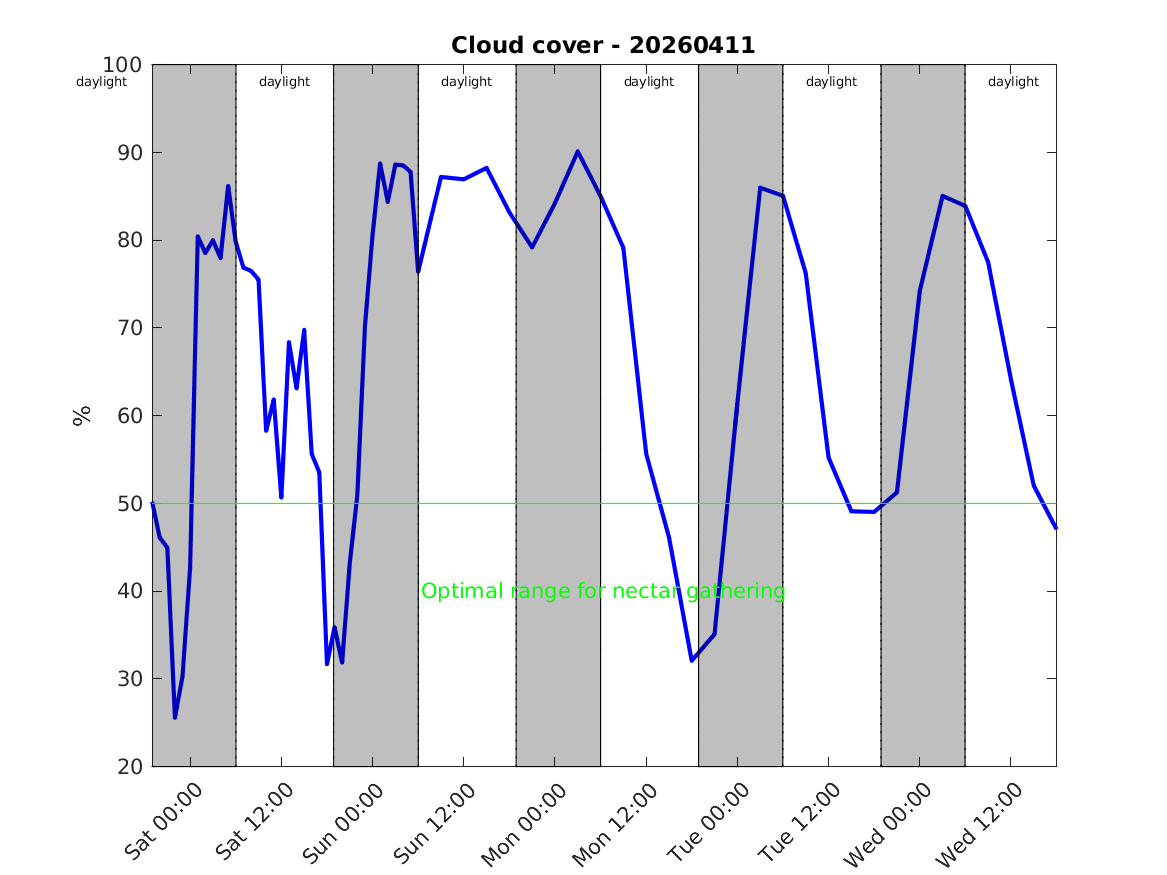 |
About this plot:
Honey bees will not fly if there is not enough light, regardless of whether the temperature is warm enough and the winds are low. They need a polarized sky to navigate long distances. If the cloud cover is heavy, and there aren't enough patches of sunlight showing through, then the bees cannot forage effectively.
When the cloud cover exceeds 75 - 90% and the maximum daily solar radiation drops below 25 W/m^2 it is assumed there is not enough polarized light to navigate by. Consequently the bees cannot forage even if the temperature and wind speeds are favorable.
Interesting Facts: A bee's eyesight is classified as trichomatic, that is they see three colors like human being beings, but they don't have a photoreciptor for red; they have one instead for ultra violet (UV). Many flowers have what has been called landing patterns outlined in UV 'colors' that guide pollinators into where the nectar is. A bee has a 280-degree field of vision, up, down, forward and back, courtesy of the 6900 facets (8600 if you are a drone, better to find the queen) in its compound eye. A bee can detect color and movement in 1/300 of a second, five times faster than the human eye.
|