| |
 |
About this plot:
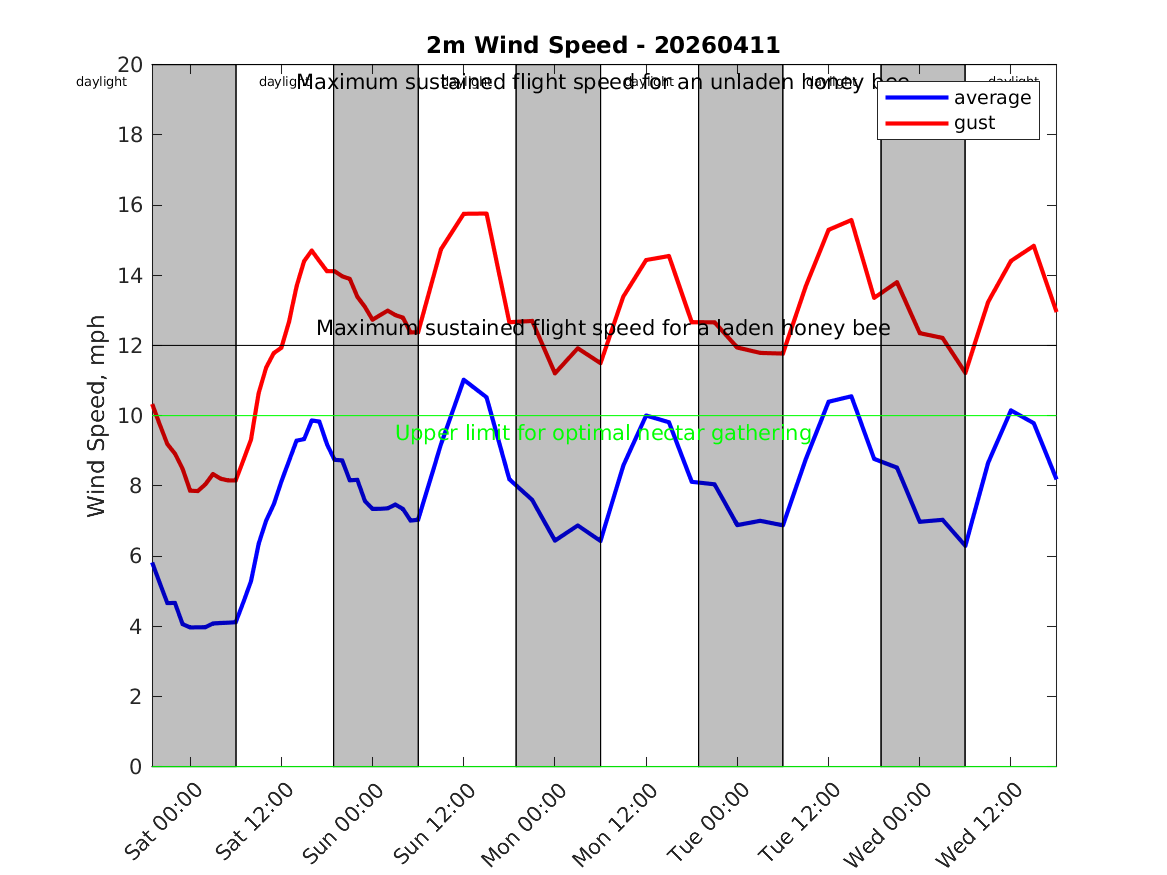
A honey bee's flight speed is approximately 15 mph. It is lower, around 12 mph, when they are laden with nectar and pollen, and higher, up to 20 mph, when unladen. Wind speeds in the range 3.5 - 15 mph (1.6 - 6.7 m/sec) can reduce foraging efficiency, most notably if the bee is flying into a strong head wind, or it is gusty.
The wind speed data from atmospheric models are always reported at 10 m (33 ft) above the ground. We use a logarithmic profile and the surface roughness of the ground to bring the wind speed down to 2 m above ground, where we assume the bees are flying. There is very little data showing at what altitude honey bees make foraging flights, but we assume it is closer to the ground where the winds are much less than at 10 m.
Interesting fact: The wings of a honey bee beat approximately 12,000 to 14,000 beats per minute (200-240 wing beats per second) in order to generate lift. Unlike the way most other insects achieve flight, honey bees use a remarkably complex pattern of wing movements to generate enough lift to carry 60% of its body weight in nectar. The wing beats also produce the insect's iconic, high-pitched buzzing sound. More information about the biology of bee wings can be found at Betterbee
|