| |
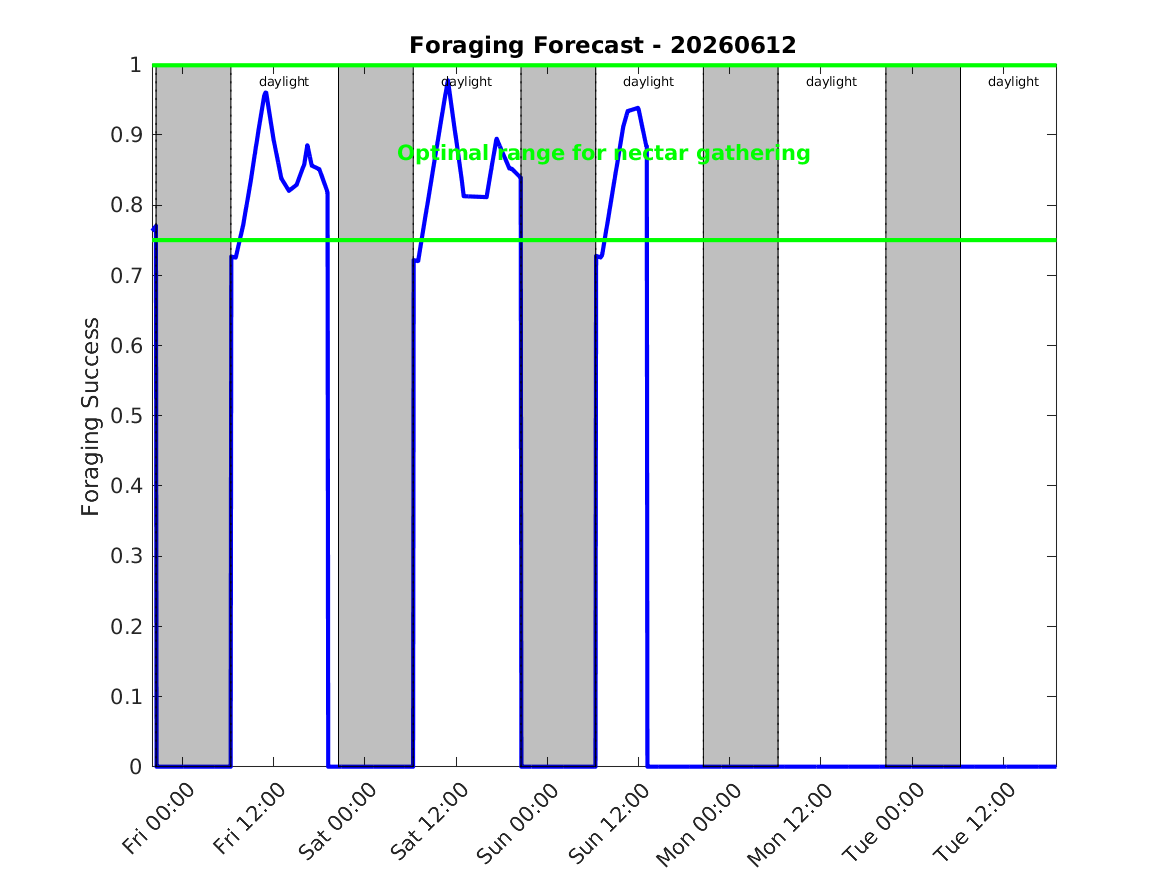 |
About this plot:
Beekeeping is one of the most weather-sensitive forms of agriculture there is. It has long been accepted that the success of the hive is highly dependent on environmental factors such as the temperature and relative humidity, precipitation, wind speed, solar radiation, cloud cover, air pressure and even air pollution.
The farther a honey bee has to fly to find resources, the less productive the hive can be. Foraging success begins with how far a honey be typically flys to reach flowers. There are numerous estimates of how far bees fly when foraging. T - Up to a 10 km (6.2 mile) radius, but typically only 3 km (1.8 mile).
- Up to 4 miles, but average of 1 - 2 miles.
- As far as five miles, but the average is less than one mile.
- A study by Pahl, 2011, shows the maximum homing distance for a honey bee ranges from 6 to 9.2 km (3.7 to 5.7 miles), meaning the bee cannot forage any farther than that or it is unable to navigate its way back to the hive.
The flow of concentrated nectar high in sugar content peaks under warm, sunny days, whereas cool or highly overcast conditions can slow the process down. Following a rain, the common thinking among beekeepers is it takes flowers 24 to 48 hours to replenish and resume normal nectar production. This is scientifically supported by a 1917 study. Some species, like clover are extremely fast, often recovering within minutes of the sun shining. Native shrubs and larger perennials may take 3 -4 days to recover.
|